
If you’ve ever started cooking or baking and realized you don’t have a 1/4-cup measuring cup, you’re probably wondering, how many tablespoons are in 1/4 cup? The good news is that the answer is simple and easy to remember. 1/4 cup equals exactly 4 tablespoons in the US measurement system.
This quick cup-to-tablespoon conversion can help you measure both dry ingredients like flour and sugar and liquid ingredients like milk or oil with confidence. Whether you’re following a new recipe, doubling ingredients, or making a quick substitution, knowing this basic kitchen measurement saves time and improves accuracy.
In this guide, you’ll learn the simple conversion formula, explore a handy kitchen conversion chart, discover practical cooking examples, and find answers to common questions about 1/4 cup to tablespoons so you can cook and bake with ease.
Quick Answer
There are 4 tablespoons in 1/4 cup using the US standard measurement system. Since 1 cup = 16 tablespoons, dividing 16 by 4 gives 4 tablespoons. This 1/4 cup to tablespoons conversion is commonly used in cooking and baking when you don’t have a 1/4-cup measuring cup available. You can use 4 level tablespoons as an accurate substitute for 1/4 cup in most recipes.
Why Does 1/4 Cup Equal 4 Tablespoons?
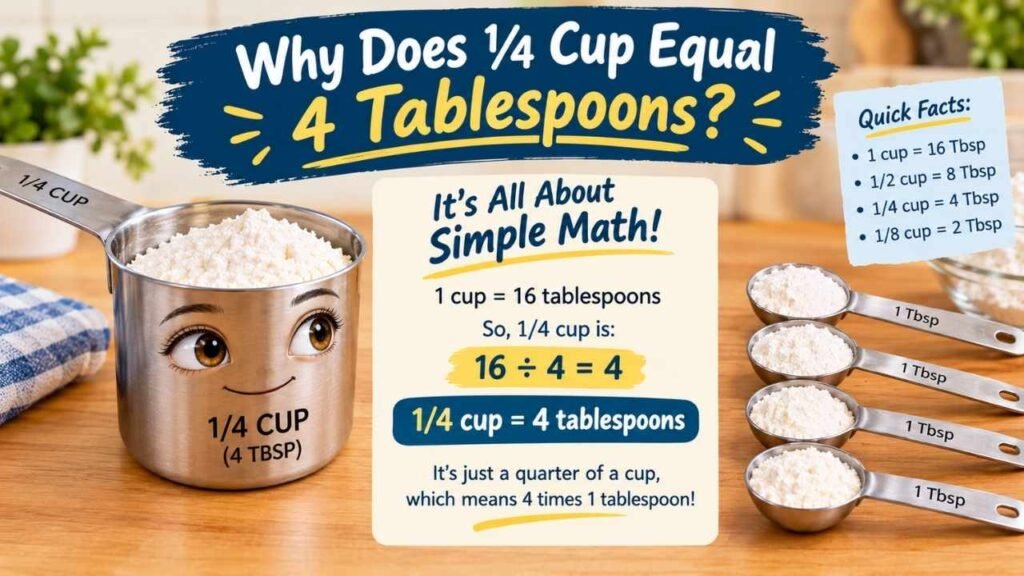
Understanding why 1/4 cup equals 4 tablespoons is easier than it may seem. In the US measurement system, 1 cup contains 16 tablespoons. Since 1/4 cup is one-fourth of a cup, you simply divide 16 by 4, which gives 4 tablespoons.
This simple cup-to-tablespoon conversion is used every day in cooking and baking because it provides an accurate way to measure ingredients when a 1/4-cup measuring cup isn’t available. Whether you’re measuring flour, sugar, butter, milk, or oil, this conversion remains the same because cups and tablespoons measure volume, not weight.
Learning this basic kitchen measurement makes recipe preparation quicker and helps you avoid measuring mistakes. If you often need similar conversions, our guide on Tablespoons in 1/3 Cup is another helpful kitchen reference.
The Simple Conversion Formula
The formula is easy to remember:
1 Cup = 16 Tablespoons
1/4 × 16 = 4 Tablespoons
Once you know this formula, you can quickly convert other cup measurements without memorizing several numbers.
How the Math Works
Think of one cup as 16 equal tablespoons. Dividing those 16 tablespoons into four equal parts gives 4 tablespoons in each part. That’s why 1/4 cup always equals 4 tablespoons in standard US recipes.
1/4 Cup to Tablespoons Conversion Chart
A kitchen conversion chart is one of the most useful tools for home cooks and bakers. Instead of calculating measurements every time, you can quickly check the amount you need and continue preparing your recipe.
While 1/4 cup equals 4 tablespoons, it’s also helpful to remember other common cup-to-tablespoon conversions for recipe scaling and substitutions. Keeping these measurements nearby saves time, improves accuracy, and reduces mistakes when cooking or baking.
Whether you’re making cookies, cakes, soups, or salad dressings, a simple measurement guide helps you work with confidence. You can even print this chart and keep it in your kitchen for quick reference whenever you need a fast recipe conversion.
Common Cup-to-Tablespoon Conversions
| Cup | Tablespoons |
| 1/8 cup | 2 tbsp |
| 1/4 cup | 4 tbsp |
| 1/3 cup | 5⅓ tbsp |
| 1/2 cup | 8 tbsp |
| 2/3 cup | 10⅔ tbsp |
| 3/4 cup | 12 tbsp |
| 1 cup | 16 tbsp |
Quick Reference Table
Saving or printing a kitchen conversion chart makes everyday cooking easier. It gives you instant access to the most common measurement conversions, helping you prepare recipes more quickly and accurately. If you’re also following baking recipes that use Celsius, our guide on 200 C to Fahrenheit can help you convert oven temperatures with ease.
How to Measure 1/4 Cup Using Tablespoons
If you don’t have a 1/4-cup measuring cup, you can still measure the correct amount using 4 level tablespoons. This method is simple, accurate, and works well for most recipes. Use a standard measuring tablespoon, fill it to the top, and level it with a straight edge for the best results.
Repeat this process four times to make 1/4 cup. This 1/4 cup to tablespoons conversion works for both dry ingredients like flour and sugar and liquid ingredients such as milk, oil, and water because tablespoons measure volume.
Knowing this basic kitchen measurement saves time, helps you adjust recipes with confidence, and ensures your cooking and baking turn out as expected.
Using Standard Measuring Spoons
Always use standard measuring spoons instead of regular dining spoons. Measuring spoons are made to hold exact amounts, making your cooking measurements and baking measurements much more accurate.
Tips for Accurate Measuring
Use level tablespoons, avoid packing dry ingredients unless the recipe says to, and measure liquids carefully to prevent spills. Small measuring habits can make a big difference in the final result.
Does This Conversion Work for Both Dry and Liquid Ingredients?
Yes. 1/4 cup equals 4 tablespoons for both dry ingredients and liquid ingredients because cups and tablespoons measure volume, not weight. Whether you’re measuring flour, sugar, cocoa powder, milk, water, melted butter, or cooking oil, the conversion remains exactly the same.
However, keep in mind that different ingredients have different weights, so 1/4 cup of flour does not weigh the same as 1/4 cup of honey or 1/4 cup of butter.
For everyday cooking and baking, using 4 level tablespoons is an accurate substitute for 1/4 cup. This simple cup-to-tablespoon conversion helps you follow recipes correctly, even when your measuring cups aren’t available.
Dry Ingredients
For dry ingredients, spoon the ingredient into the tablespoon and level it with a knife. Avoid scooping directly from the container, as this can pack ingredients like flour and affect your recipe.
Liquid Ingredients
For liquid ingredients, fill each tablespoon carefully without overflowing. This keeps your measurements accurate and helps maintain the right consistency in sauces, batters, and baked goods.
Common Recipe Examples Using 1/4 Cup
You’ll find 1/4 cup listed in many everyday recipes, making this one of the most useful kitchen conversions to remember. Since 1/4 cup equals 4 tablespoons, you can easily replace a measuring cup with tablespoons whenever needed.
This is especially helpful when preparing cookies, cakes, pancakes, sauces, marinades, or salad dressings. Using the correct recipe conversion helps keep flavors balanced and textures consistent.
Whether you’re measuring butter, sugar, flour, milk, or cooking oil, understanding this simple conversion saves time and improves accuracy. Once you remember that 4 tablespoons equal 1/4 cup, following recipes becomes easier, even if you don’t have every measuring tool in your kitchen.
Butter
1/4 cup of butter = 4 tablespoons. Many butter wrappers include tablespoon markings, making this conversion quick and easy.
Sugar
Measure 4 level tablespoons of sugar to replace 1/4 cup. Level each spoon for the most accurate result.
Flour
Spoon flour into each tablespoon and level it instead of scooping directly from the bag. This prevents using too much flour.
Milk
For recipes calling for 1/4 cup of milk, simply measure 4 tablespoons. This works for all types of milk.
Cooking Oil
Whether using olive oil, vegetable oil, or canola oil, 4 tablespoons provide the same amount as 1/4 cup.
US vs Australian Tablespoon Measurements
Most recipes follow the US measurement system, where 1 tablespoon equals about 14.8 milliliters, and 1 cup contains 16 tablespoons. In Australia, however, a tablespoon is 20 milliliters, making it larger than the US version.
The good news is that a 1/4 metric cup is still designed to equal 4 Australian tablespoons, so recipes stay consistent within each measurement system.
Problems usually happen only when someone mixes US measuring spoons with Australian recipes, or the other way around. If you’re using recipes from another country, always check which measurement system they use. This simple step helps you avoid measuring mistakes and achieve better cooking and baking results.
Key Differences
The main difference is the tablespoon size: US tablespoon ≈ 14.8 mL, while an Australian tablespoon = 20 mL. Using the correct measuring tools ensures accurate recipe results.
When the Conversion Changes
The conversion only becomes confusing when US and Australian measuring tools are mixed. Using the correct set for your recipe keeps ingredient measurements accurate and consistent.
Related Kitchen Measurement Conversions
Knowing a few extra kitchen measurement conversions can make cooking and baking much easier. While 1/4 cup equals 4 tablespoons, other common conversions are just as useful when you’re adjusting recipes or measuring ingredients without a full set of cups.
Learning these basic cup-to-tablespoon conversions saves time and helps you prepare recipes with confidence. Instead of stopping to search for every measurement, you can quickly calculate the amount you need.
Whether you’re doubling a recipe, cutting it in half, or making a small batch, these simple conversions improve accuracy and keep your ingredients balanced. Below are some of the most common measurements every home cook should know.
1/8 Cup
A 1/8 cup equals 2 tablespoons. This small measurement is often used for spices, sauces, melted butter, and other ingredients in smaller recipes. If you don’t have a 1/8-cup measuring cup, simply use 2 level tablespoons for an accurate substitute.
1/3 Cup
A 1/3 cup equals 5⅓ tablespoons. You can also measure it as 5 tablespoons plus 1 teaspoon, making it easier when a 1/3-cup measuring cup isn’t available.
1/2 Cup
A 1/2 cup equals 8 tablespoons. This is one of the easiest kitchen conversions to remember and is commonly used in baking and cooking.
3/4 Cup
A 3/4 cup equals 12 tablespoons. This measurement appears in many recipes for cakes, breads, sauces, and dressings.
1 Cup
A 1 cup equals 16 tablespoons. Once you remember this basic conversion, calculating smaller cup measurements becomes much easier.
How to Double or Halve Recipes Using Tablespoons
Understanding cup-to-tablespoon conversions makes it easy to adjust recipes for any serving size. Since 1/4 cup equals 4 tablespoons, doubling the amount simply means using 8 tablespoons, which is the same as 1/2 cup. If you want to make half the recipe, use 2 tablespoons, which equals 1/8 cup.
These simple calculations help you prepare the right amount of food without changing the balance of ingredients. This is especially useful when cooking for fewer people or making larger batches for family gatherings. Learning these basic recipe scaling techniques helps you save ingredients, reduce waste, and achieve consistent results every time you cook or bake.
Kitchen Measuring Tips to Improve Accuracy
Good measuring habits can make a big difference in your cooking and baking results. Always use standard measuring cups and spoons instead of regular kitchen utensils because they provide more accurate measurements. Level dry ingredients with the flat edge of a knife, and avoid packing flour unless the recipe specifically says to do so.
For liquids, measure on a flat surface to prevent overfilling or spills. It’s also helpful to read the entire recipe before you begin measuring ingredients. Following these simple kitchen measurement tips improves accuracy, reduces mistakes, and helps your recipes turn out with the right texture, flavor, and consistency every time.
Level vs Heaping Tablespoons
A level tablespoon has a flat top and is the standard measurement used in recipes. A heaping tablespoon contains more than the required amount and should only be used when a recipe specifically asks for it.
Avoiding Common Measuring Mistakes
Use the correct measuring tools, double-check ingredient amounts, and avoid guessing measurements. Small mistakes can affect the taste, texture, and overall quality of your finished dish.
When to Use Measuring Cups Instead of Tablespoons
Although 4 tablespoons equal 1/4 cup, measuring cups are often the better choice when preparing larger amounts or following recipes that require several cup measurements. Measuring cups are faster, reduce the chance of counting mistakes, and make it easier to work with multiple ingredients.
Tablespoons are ideal when replacing a missing 1/4-cup measuring cup or measuring small quantities. For baking, where precision is especially important, using the correct measuring cup whenever possible can help produce more consistent results.
Having both measuring cups and measuring spoons in your kitchen gives you the flexibility to handle recipes of all sizes with confidence.
Quick Kitchen Conversion Cheat Sheet
Keeping a simple kitchen conversion cheat sheet nearby can save time and make recipe preparation much easier. Here are some of the most useful conversions to remember:
| Measurement | Equivalent |
| 1 Cup | 16 Tablespoons |
| 3/4 Cup | 12 Tablespoons |
| 2/3 Cup | 10⅔ Tablespoons |
| 1/2 Cup | 8 Tablespoons |
| 1/3 Cup | 5⅓ Tablespoons |
| 1/4 Cup | 4 Tablespoons |
| 1/8 Cup | 2 Tablespoons |
| 1 Tablespoon | 3 Teaspoons |
This quick reference helps you measure ingredients accurately and reduces the need to calculate conversions while cooking.
FAQs
Is 1/4 cup equal to 4 tablespoons?
Yes. In the US measurement system, 1/4 cup equals exactly 4 tablespoons.
Can I replace a 1/4 cup with 4 tablespoons?
Yes. 4 level tablespoons are an accurate substitute for 1/4 cup in most cooking and baking recipes.
How many teaspoons are in 1/4 cup?
Since 1 tablespoon equals 3 teaspoons, 1/4 cup (4 tablespoons) equals 12 teaspoons.
What is 1/4 cup in milliliters?
A US 1/4 cup is approximately 59 milliliters (mL).
Does this conversion change outside the US?
The relationship within each country’s measuring system stays consistent, but US and Australian tablespoons are different sizes, so always check which system your recipe uses.
Conclusion
Knowing that 1/4 cup equals 4 tablespoons is a simple kitchen skill that makes cooking and baking easier. Whether you’re measuring dry ingredients or liquid ingredients, this basic cup-to-tablespoon conversion helps you prepare recipes accurately without needing every measuring cup.
By learning the conversion formula, using the correct measuring tools, and keeping a kitchen conversion chart nearby, you can save time and avoid common measuring mistakes.
Remember a few other common conversions as well, and you’ll be ready to scale recipes, make substitutions, and cook with confidence. With these practical tips, measuring ingredients becomes quicker, simpler, and more accurate every time.