
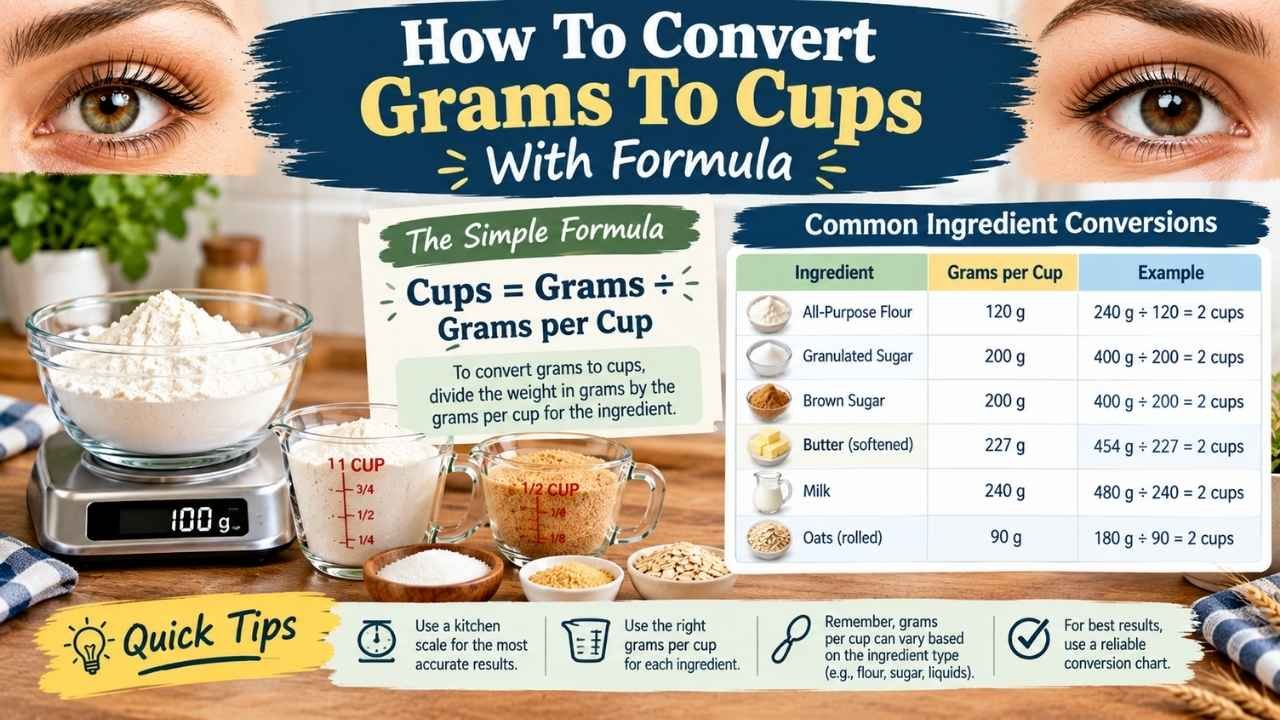
If you’ve ever followed a recipe that lists ingredients in grams while your measuring tools use cups, you’re not alone. Learning how to convert grams to cups can make cooking and baking much easier, especially when using international recipes.
The important thing to remember is that grams measure weight, while cups measure volume, so the conversion depends on the ingredient. For example, 100 grams of flour does not equal the same number of cups as 100 grams of sugar.
In this guide, you’ll find a simple grams to cups conversion formula, easy conversion charts, and practical examples for common ingredients such as flour, sugar, butter, rice, and water. Whether you need a quick grams to cups calculator or a detailed reference, this article will help you convert measurements accurately.
Quick Answer
To convert grams to cups, divide the number of grams by the ingredient’s density. A simple grams to cups formula is: Cups = Grams ÷ Ingredient Density. Because ingredients have different densities, 100 grams of flour, sugar, or butter will not equal the same number of cups. Use a reliable grams to cups conversion chart for accurate cooking and baking measurements.
Grams to Cups Conversion Formula
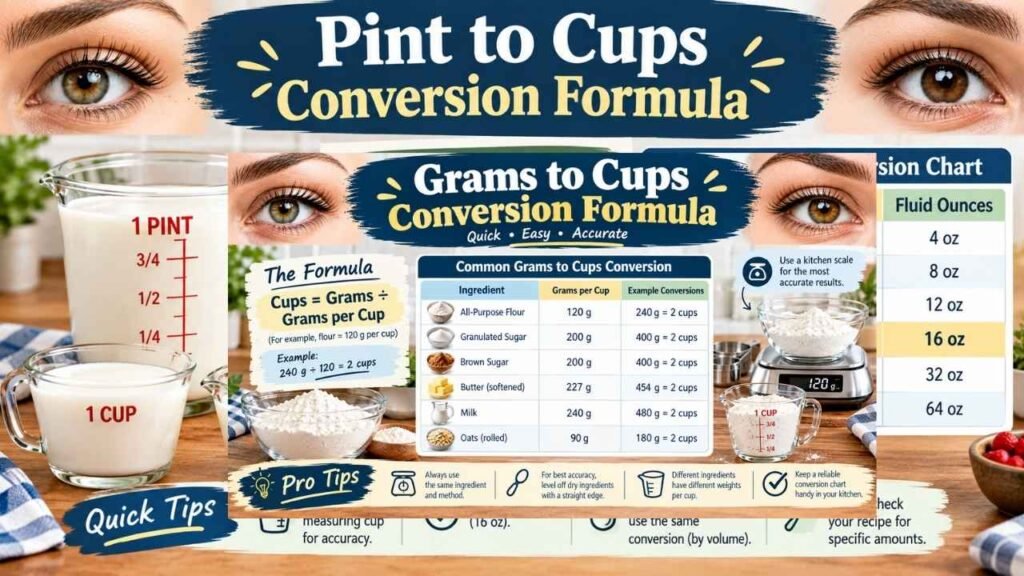
The most accurate grams to cups conversion uses the ingredient’s density. The formula is Cups = Grams ÷ Ingredient Density. For example, if all-purpose flour has a density of about 125 grams per cup, then 250 grams ÷ 125 = 2 cups.
This simple method works for flour, sugar, butter, rice, and many other ingredients. A grams to cups calculator performs the same calculation automatically, but understanding the formula helps you convert any amount by hand.
Remember that liquids and dry ingredients use different densities, so always check the ingredient before converting. Using the correct formula is especially important in baking, where small measurement errors can affect texture, rise, and overall recipe success.
Why Grams and Cups Are Not the Same
Grams measure weight, while cups measure volume. This is why 100 grams of flour does not take up the same space as 100 grams of sugar. Flour is lighter and more airy, while sugar is denser and heavier. Butter, rice, and water each have their own density as well.
Because of these differences, a universal gram to cup converter cannot give one answer for every ingredient. Professional bakers usually prefer grams because weight measurements are more precise.
If you are following an international recipe, a reliable grams to cups chart helps you match the correct amount. Understanding this difference is the key to making accurate conversions and avoiding common cooking mistakes.
Grams to Cups Conversion Chart (50g to 500g)
Here is a simple grams to cups conversion chart for all-purpose flour: 50g = 0.4 cup, 100g = 0.8 cup, 150g = 1.2 cups, 200g = 1.6 cups, 250g = 2 cups, and 500g = 4 cups. These values are approximate because flour density can vary slightly depending on how it is scooped. Similar charts can be made for sugar, butter, rice, and other ingredients.
Keeping a conversion chart nearby saves time and reduces the need for repeated calculations. If you frequently use recipe conversions, this chart works like a quick grams to cups calculator and helps you measure ingredients more confidently in the kitchen.
How Many Cups Is 100 Grams?
The answer depends on the ingredient. 100 grams of all-purpose flour equals about 0.8 cup. 100 grams of granulated sugar equals about 0.5 cup. 100 grams of butter equals about 0.44 cup, while 100 grams of water equals about 0.42 cup. This is why recipes often specify the ingredient when asking how many cups is 100 grams.
Using the correct conversion gives better results, especially in baking. If you are converting several ingredients at once, a grams to cups conversion chart is much faster than calculating each value separately. Accurate measurements help cakes, breads, and cookies turn out the way the recipe intended.
How Many Cups Is 250 Grams?
For all-purpose flour, 250 grams equals about 2 cups. For granulated sugar, 250 grams equals about 1.25 cups. For butter, 250 grams equals about 1.1 cups. Because each ingredient has a different density, the answer changes depending on what you are measuring.
This is one of the most searched grams to cups questions because many baking recipes use 250 grams as a standard amount. When converting larger quantities, it is helpful to check a grams to cups chart instead of estimating. If you often bake bread, cakes, or cookies, knowing how many cups is 250 grams can save time and improve consistency in your recipes.
Grams to Cups for Flour
Flour is one of the most common ingredients people convert from grams to cups. 125 grams of all-purpose flour is roughly 1 cup, so 250 grams of flour is about 2 cups. Whole wheat flour is slightly denser, while bread flour can vary depending on the brand. When measuring flour, spoon it into the cup and level it off instead of scooping directly from the bag.
Scooping packs the flour and can add extra weight. This is why professional bakers prefer grams for accuracy. If you are following a recipe that uses cups, a reliable grams to cups flour conversion chart will help you get consistent results every time.
Recommended Articles
Many home cooks also use other kitchen conversions alongside grams to cups measurements. For example, understanding How Many Cups in a Pint can help when scaling soups, sauces, and drink recipes.
When baking, oven temperature matters just as much as accurate measurements. If a recipe lists a temperature in Celsius, 220 C to F is a useful reference for setting your oven correctly.
Another helpful conversion is How many tablespoons in 1 cup, especially when you need to measure smaller ingredient amounts without a full cup measure.
Grams to Cups for Sugar
Sugar has a different density than flour, so the conversion is not the same. 200 grams of granulated sugar is about 1 cup, while 100 grams of sugar is about 0.5 cup. Brown sugar can vary depending on whether it is packed tightly or measured loosely. Powdered sugar is lighter and usually takes up more volume than granulated sugar.
Because of these differences, it is important to use the correct grams to cups sugar conversion for the type of sugar in your recipe. Accurate sugar measurements help control sweetness, texture, and moisture in cakes, cookies, and desserts. A dedicated grams to cups chart for sugar is one of the most useful baking references.
Grams to Cups for Butter
Butter is denser than flour and sugar, so it converts differently. 100 grams of butter equals about 0.44 cup, while 250 grams of butter equals about 1.1 cups. Many baking recipes rely on precise butter measurements because butter affects texture, richness, and structure. If you are converting from grams to cups, it is best to use a kitchen scale when possible.
However, a grams to cups butter conversion chart works well for quick measurements. When measuring softened butter in a cup, press it gently to remove air gaps. Using accurate butter conversions can make a noticeable difference in cookies, pastries, and cakes.
Grams to Cups for Rice
Rice also has its own conversion rate. 100 grams of uncooked white rice equals about 0.5 cup, while 200 grams is close to 1 cup. Brown rice is slightly less dense, so the volume can vary a little. Because rice expands during cooking, it is important to measure the uncooked amount first.
A grams to cups rice conversion chart helps when adjusting serving sizes for family meals. If a recipe from another country lists rice in grams, converting it accurately ensures the correct texture and yield after cooking.
The Most Accurate Way to Convert Grams to Cups
The most accurate method is to use a digital kitchen scale. A scale measures weight directly, so you do not need to worry about ingredient density or packing differences.
If you must use cups, always check a reliable grams to cups conversion chart for the specific ingredient. Spoon dry ingredients into the measuring cup and level them with a straight edge.
Avoid scooping directly from the container, which can add extra weight. For liquids, place the cup on a flat surface and check the measurement at eye level. These small steps make your grams to cups conversion much more accurate and help recipes turn out consistently.
Common Grams-to-Cups Conversion Mistakes
One common mistake is assuming that 100 grams of every ingredient equals the same number of cups. Another is using the wrong type of cup, such as a metric cup instead of a US cup.
Scooping flour directly from the bag can also pack it tightly and increase the weight. Ignoring ingredient density is another major error when using a gram to cup converter.
Some cooks also forget that brown sugar should usually be packed, while powdered sugar should be measured lightly. Checking a grams to cups chart before measuring can help you avoid these problems and improve the accuracy of your cooking and baking.
FAQs
Is 250g equal to 1 cup?
No. For flour, 250 grams is about 2 cups. For sugar, it is about 1.25 cups.
How many cups is 200g?
200 grams of flour is about 1.6 cups, while 200 grams of sugar is about 1 cup.
Can I convert grams to cups without a scale?
Yes. Use a reliable grams to cups conversion chart for the specific ingredient you are measuring.
Why do flour and sugar have different conversions?
Flour and sugar have different densities, so the same weight takes up a different amount of volume.
Conclusion
Knowing how to convert grams to cups makes it much easier to follow recipes from different countries and measure ingredients correctly. The key point is that grams measure weight and cups measure volume, so the conversion changes based on the ingredient. Flour, sugar, butter, rice, and water all have different densities, which is why a single universal conversion does not work for every recipe.
For the best accuracy, use a digital kitchen scale whenever possible. If you need a quick measurement, a reliable grams to cups conversion chart can help you convert common amounts such as 100 grams, 200 grams, and 250 grams with confidence.
By using the correct formula and checking ingredient-specific conversions, you can improve your cooking and baking results and avoid common measurement mistakes.