

How many grams in a tablespoon? This is one of the most common questions people ask when following a recipe or converting kitchen measurements. The answer is not always the same because grams per tablespoon can change depending on the ingredient.
For example, 1 tbsp to grams for water is different from flour, sugar, or butter. Understanding tablespoon to grams conversions helps you avoid mistakes in cooking and baking and makes recipes more accurate.
In this guide, you’ll learn how many grams are in a tablespoon for common ingredients, see a simple tablespoon to grams chart, and discover how to convert tablespoon to grams quickly.
Whether you are a beginner cook or an experienced baker, this easy guide will help you measure ingredients with confidence and improve your results in the kitchen.
Quick Answer
A US tablespoon equals 15 milliliters, but its weight in grams depends on the ingredient. For example, 1 tablespoon of water weighs about 15 grams, while flour weighs around 7.8 grams. Sugar, butter, salt, and honey have different weights due to their density. So, when converting tablespoons to grams, always check the specific ingredient to get an accurate measurement for cooking or baking.
Why the Gram Value Changes by Ingredient
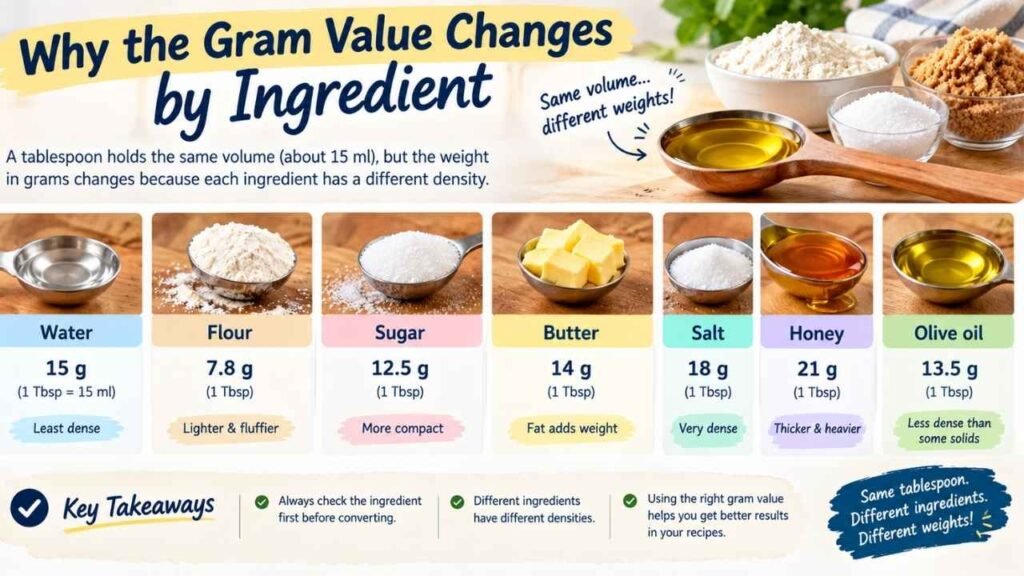
Tablespoon to grams conversions can be confusing because tablespoons measure volume while grams measure weight. Two ingredients can fill the same tablespoon but weigh very different amounts. For example, flour is light and airy, while honey is thick and heavy.
That is why grams in 1 tablespoon are not the same for every food. Understanding ingredient density is the key to accurate cooking and baking. When a recipe asks for a tablespoon, the amount of grams depends on what you are measuring.
This is also why professional bakers often prefer weighing ingredients instead of using measuring spoons. Accurate weight conversion gives more consistent results, especially in baking.
Tablespoon to Grams Conversion Chart
Here is a quick tablespoon to grams chart for common ingredients. 1 tablespoon of water = 15 g, all-purpose flour = 7.8 g, granulated sugar = 12.5 g, brown sugar = 13.5 g, butter = 14.2 g, salt = 18 g, and honey = 21 g.
These values are widely used in kitchen measurements and recipe conversions. If you need a fast tablespoon gram converter, this chart is a useful reference.
Many cooks keep a kitchen conversion chart nearby to make recipes easier to follow. Using the correct conversion helps improve accuracy when cooking, baking, or scaling recipes for larger or smaller servings.
How Many Grams in a Tablespoon of Flour?
How many grams in a tablespoon of flour? One level tablespoon of all-purpose flour weighs about 7.8 grams. This is one of the most searched tablespoon to grams conversions because flour is used in many baking recipes. If the flour is packed tightly, the weight can be slightly higher.
For best results, spoon the flour into the tablespoon and level it off with a knife. Accurate baking measurements are important because too much flour can make cakes, cookies, and bread dry. When people search for 1 tablespoon flour in grams or grams in tbsp flour, the standard answer is approximately 7.8 grams for a level tablespoon.
How Many Grams in a Tablespoon of Sugar?
How many grams in a tablespoon of sugar? One tablespoon of granulated sugar weighs about 12.5 grams. This is a useful conversion when reducing or increasing recipe quantities. Because sugar is denser than flour, it weighs more even though the volume is the same.
If you are trying to convert tablespoon to grams for baking, using the correct sugar weight helps maintain the texture and sweetness of the recipe.
Many people search for 1 tablespoon sugar in grams or grams in tbsp sugar when following international recipes. A standard level tablespoon of granulated sugar is generally accepted as 12.5 grams, making it a reliable grams conversion chart reference.
How Many Grams in a Tablespoon of Butter?
How many grams in a tablespoon of butter? A level tablespoon of butter weighs about 14.2 grams. This conversion is especially helpful for cooking and baking because many recipes list butter in grams instead of tablespoons.
When measuring butter, use a level tablespoon for the most accurate result. Knowing grams per tablespoon makes it easier to follow international recipes and avoid guesswork.
If you are searching for 1 tablespoon butter in grams or grams in tbsp butter, the standard answer is around 14.2 grams. For additional kitchen conversions, you may also find How Many Tablespoons in an Ounce useful when converting butter and other ingredients.
How Many Grams in a Tablespoon of Honey?
How many grams in a tablespoon of honey? One tablespoon of honey weighs about 21 grams, making it one of the heaviest common ingredients measured by the tablespoon. Honey is thick and dense, so it weighs much more than flour or sugar.
If you are trying to convert tablespoon to grams for sauces, desserts, or baking, using the correct honey weight is important for both sweetness and texture.
Many people search for 1 tablespoon honey in grams or grams in tbsp honey when following recipes from different countries. A quick reference is that 1 tablespoon of honey = approximately 21 grams. This conversion is especially useful when scaling recipes up or down.
How Many Grams in a Tablespoon of Salt?
How many grams in a tablespoon of salt? A level tablespoon of table salt weighs about 18 grams. Salt is denser than most dry ingredients, so its weight is higher than flour or sugar. This tablespoon to grams conversion is useful when preparing bread dough, brines, or seasoning mixes.
Because salt has a strong effect on flavor, accurate measurement is important. If you are searching for 1 tablespoon salt in grams or grams in tbsp salt, the standard answer is about 18 grams. For other kitchen conversions, you might also like Tablespoons in 1/2 Cup and How Many Tablespoons in 2/3 Cup when adjusting recipe quantities.
US vs Australian Tablespoon: What’s the Difference?
A common mistake in tablespoon to grams conversions is assuming all tablespoons are the same. A US tablespoon equals 15 mL, while an Australian tablespoon equals 20 mL. Because the Australian spoon is larger, it holds more of an ingredient and therefore weighs more.
For example, 1 tablespoon of water is about 15 grams in the US system but about 20 grams in the Australian system. If you are following an international recipe, always check which measurement standard is being used.
This simple step can prevent problems with texture, flavor, and consistency. Understanding US tablespoon to grams conversions is especially important for baking and precise recipe measurements.
How to Convert Tablespoons to Grams Manually
You can convert tablespoon to grams manually by using a simple formula: grams = tablespoons × ingredient density. For water, the density is close to 1, so 1 tablespoon equals about 15 grams. For flour, sugar, butter, and other ingredients, the density changes, so the gram value also changes.
This is why grams per tablespoon are different for each ingredient. If a recipe calls for 2 tablespoons of sugar, you can estimate 2 × 12.5 = 25 grams. Learning this method makes weight conversion easier and helps when you do not have a calculator nearby. It is a useful skill for cooking, baking, and adjusting recipe quantities.
Common Cooking and Baking Conversions
Knowing a few common cooking measurements can save time in the kitchen. 1 tablespoon = 3 teaspoons, 2 tablespoons = 1 fluid ounce, 4 tablespoons = 1/4 cup, and 8 tablespoons = 1/2 cup. These quick conversions are helpful when scaling recipes up or down.
Many home cooks keep a kitchen conversion chart for fast reference. When combined with tablespoon to grams values, these measurements make recipe adjustments much easier.
For example, if a recipe uses 1/2 cup of butter, you can convert it to tablespoons first and then to grams if needed. Accurate recipe conversions help maintain the correct texture and flavor in both cooking and baking.
How to Measure Grams Without a Kitchen Scale
If you do not have a scale, a tablespoon gram converter chart can still help you measure ingredients with reasonable accuracy. Use level measuring spoons and avoid packing dry ingredients unless the recipe specifically says so.
For example, 1 tablespoon of flour is about 7.8 grams, sugar is about 12.5 grams, and butter is about 14.2 grams. This method is not as precise as a digital scale, but it works well for many everyday recipes.
When measuring sticky ingredients like honey, lightly oil the spoon first so the ingredient releases easily. Understanding grams in 1 tablespoon for common foods allows you to prepare recipes even when special equipment is not available.
FAQs
Is 1 tablespoon always 15 grams?
No. A US tablespoon holds 15 mL, but the grams per tablespoon depend on the ingredient. Water is about 15 g, flour about 7.8 g, and honey about 21 g.
How many grams are in 2 tablespoons?
For water, 2 tablespoons = about 30 grams. For flour, it is about 15.6 grams. Always check the ingredient before converting.
What is the most accurate way to convert tablespoons to grams?
The most accurate method is to use a digital kitchen scale. Measuring by weight gives more consistent results than measuring by volume.
Why do bakers prefer grams instead of tablespoons?
Grams provide exact weight conversion and reduce errors caused by packed or unevenly filled measuring spoons.
Conclusion
How many grams in a tablespoon? The answer depends on the ingredient. A US tablespoon equals 15 mL, but the weight can range from about 7.8 g for flour to 21 g for honey.
Understanding tablespoon to grams conversions helps you follow recipes accurately, avoid measurement mistakes, and achieve better cooking and baking results.
Whether you need 1 tbsp to grams for flour, sugar, butter, salt, or honey, using the correct conversion will improve consistency in the kitchen. Keep a simple tablespoon to grams chart nearby for quick reference whenever you prepare a recipe.