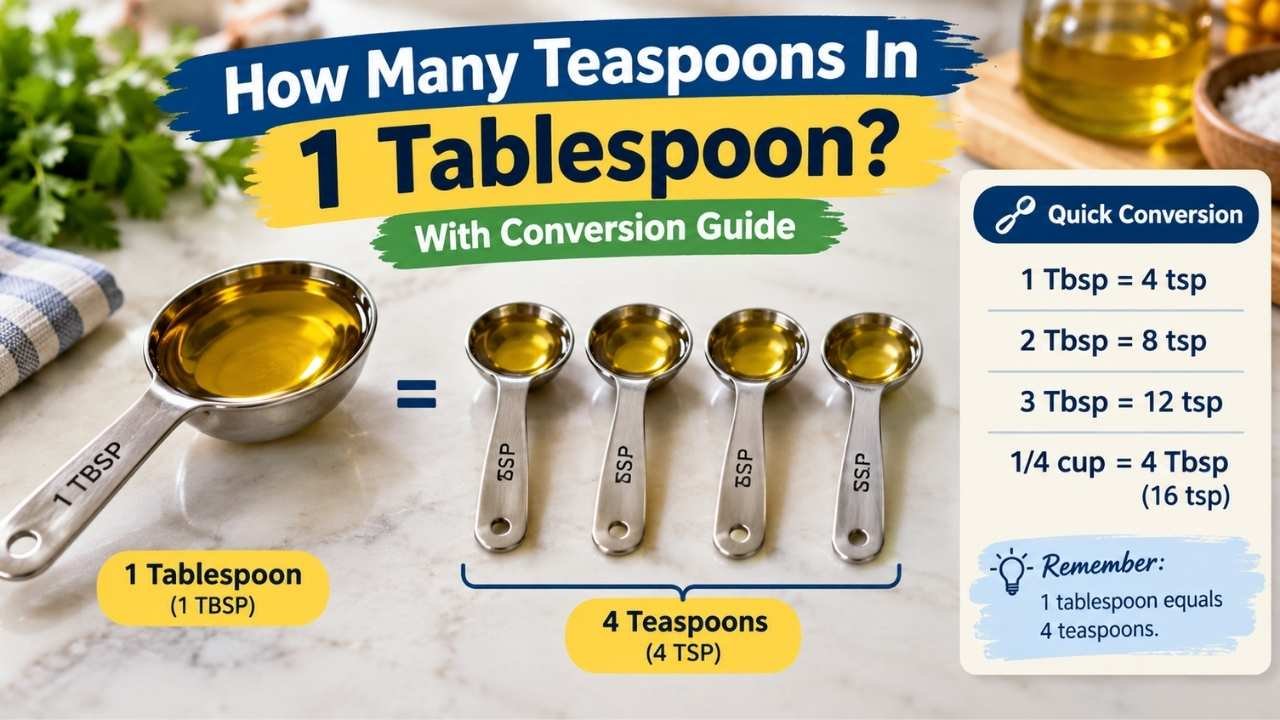
If you’re wondering how many teaspoons in 1 tablespoon, the answer is simple: 1 tablespoon equals 3 teaspoons. This is one of the most common kitchen measurement conversions used in cooking and baking. Whether you’re following a recipe, doubling ingredients, or using a tablespoon to teaspoon conversion chart, knowing this quick conversion can save time and prevent mistakes.
Many home cooks search for how many teaspoons are in a tablespoon when adjusting recipe measurements or converting tbsp to tsp. Since a tablespoon is larger than a teaspoon, understanding the correct ratio helps keep flavors balanced and recipes accurate.
In this guide, you’ll learn the exact conversion, an easy formula, a helpful chart, and practical tips for everyday cooking and baking. Everything is explained in simple terms so you can use the conversion with confidence.
Quick Answer
There are 3 teaspoons in 1 tablespoon. This is the standard tablespoon to teaspoon conversion used in most US recipes. If you need to convert tbsp to tsp, simply multiply the number of tablespoons by 3. For example, 1 tablespoon = 3 teaspoons, 2 tablespoons = 6 teaspoons, and 1/2 tablespoon = 1.5 teaspoons.
How Many Teaspoons Are in a Tablespoon?
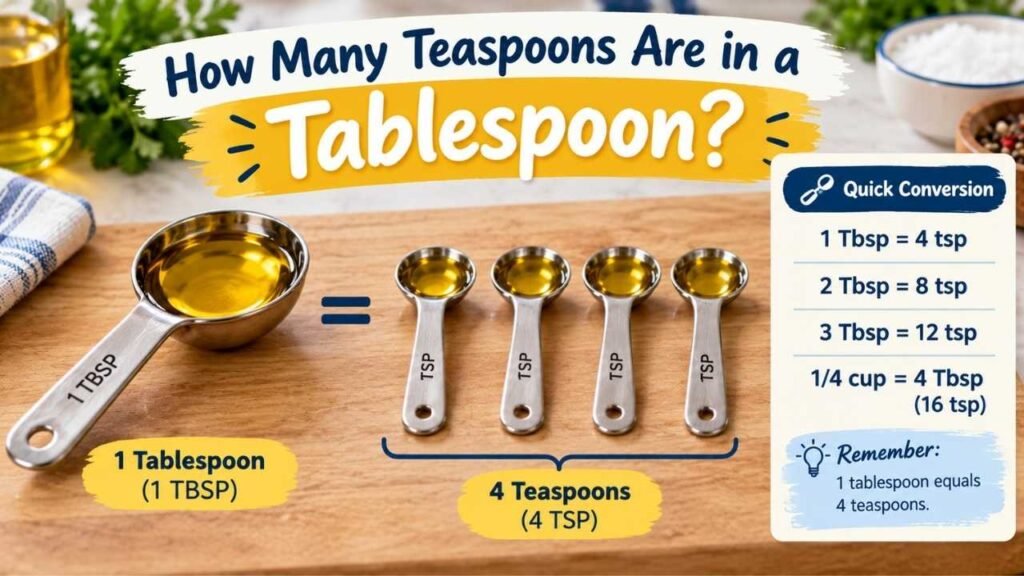
1 tablespoon = 3 teaspoons. This is the standard tablespoon to teaspoon conversion used in most US recipes. If a recipe asks for one tablespoon and you only have a teaspoon, you can measure three teaspoons instead. Many people search for how many teaspoons in 1 tablespoon because this conversion appears in baking, cooking, and meal preparation every day.
The same rule applies when converting tbsp to tsp for sauces, spices, and liquid ingredients. Knowing this simple ratio helps you follow recipes correctly and avoid adding too much or too little of an ingredient. It is one of the easiest and most useful cooking measurement conversions to remember in the kitchen.
Tablespoon to Teaspoon Conversion Formula
A simple formula makes this conversion easy. Teaspoons = Tablespoons × 3. This means you multiply the number of tablespoons by three to find the number of teaspoons. For example, 1 tablespoon = 3 teaspoons, 2 tablespoons = 6 teaspoons, and 1/2 tablespoon = 1.5 teaspoons.
This formula is useful when scaling recipes or when you do not have the exact measuring spoon available. Many cooks use this teaspoon conversion formula while preparing soups, sauces, and baked goods.
If you often convert tablespoon and teaspoon measurements, remembering the number three will save time. It is one of the fastest ways to handle kitchen measurement conversions without using a calculator.
Quick Tablespoon to Teaspoon Conversion Chart
A tablespoon to teaspoon conversion chart is helpful when you need a quick reference while cooking. The most common conversions are: 1 tablespoon = 3 teaspoons, 2 tablespoons = 6 teaspoons, 3 tablespoons = 9 teaspoons, and 4 tablespoons = 12 teaspoons. For smaller amounts, 1/2 tablespoon = 1.5 teaspoons, 1/3 tablespoon = 1 teaspoon, and 1/4 tablespoon = 0.75 teaspoon.
Keeping these numbers in mind can make recipe preparation much easier. Many home cooks use a teaspoon conversion chart to avoid repeated calculations. This chart is especially useful for baking, where accurate measurements can affect texture, flavor, and the final result of the recipe.
Why Recipes Use Both Tablespoons and Teaspoons
Recipes often use both tablespoons and teaspoons because different ingredients require different amounts. A tablespoon is useful for larger quantities, while a teaspoon is better for smaller amounts such as salt, baking powder, vanilla, or spices.
Understanding how many teaspoons are in a tablespoon helps you switch between these measurements without changing the recipe. For example, if a recipe needs 1 tablespoon of an ingredient, you can use 3 teaspoons instead.
This flexibility is helpful when measuring tools are limited. Accurate cooking and baking measurements help keep flavors balanced and ensure the recipe turns out as expected. Just as conversions are useful in the kitchen, people often use guides like How Many Quarts in a Gallon and 120 C to F for other everyday measurement needs.
Common Cooking and Baking Examples
Knowing the tablespoon to teaspoon conversion is useful in many recipes. If a cookie recipe calls for 1 tablespoon of vanilla extract, you can use 3 teaspoons instead. A salad dressing that needs 2 tablespoons of lemon juice can be measured as 6 teaspoons.
Even spice blends become easier to prepare when you know how many teaspoons in 1 tablespoon. For example, 1/2 tablespoon of garlic powder equals 1.5 teaspoons. These simple conversions help when your measuring spoon set is incomplete or when you are adjusting recipe sizes.
Many home cooks keep a recipe conversion table nearby for quick reference. Accurate measurements are especially important in baking, where small changes can affect the final texture and flavor.
US vs Australian Tablespoon Measurements
Most recipes in the United States use a tablespoon that equals 15 milliliters, which is the same as 3 teaspoons. However, Australia uses a larger tablespoon that equals 20 milliliters. Because of this, 1 Australian tablespoon equals 4 teaspoons, not 3. This difference is important when following international recipes.
If you use a US measuring spoon for an Australian recipe, the ingredient amount may be slightly smaller than intended. Understanding these regional differences can help you avoid measurement mistakes.
When searching for how many teaspoons are in a tablespoon, it is usually safe to assume the standard US conversion unless the recipe specifically mentions Australian measurements. This is one of the most overlooked details in kitchen measurement conversions.
How Many Milliliters Are in a Tablespoon and Teaspoon?
In standard US measurements, 1 tablespoon equals 15 milliliters (mL), and 1 teaspoon equals 5 milliliters (mL). This is why 1 tablespoon = 3 teaspoons. Understanding the milliliter values makes the tablespoon to teaspoon conversion easier to remember. If you multiply 5 mL by 3, you get 15 mL, which matches one tablespoon.
Many recipes, especially international ones, use milliliters instead of spoons. Knowing both systems helps when converting liquids such as oil, milk, or vanilla extract.
It also makes it easier to follow recipes from different countries. Whether you are measuring in spoons or milliliters, the same ratio applies, making this one of the most useful cooking measurement conversions to know.
How to Scale Recipes Using This Conversion
Recipe scaling becomes much easier when you know how many teaspoons are in a tablespoon. To double a recipe, simply double the number of tablespoons and then convert if needed. For example, 2 tablespoons = 6 teaspoons, and 4 tablespoons = 12 teaspoons. If you are cutting a recipe in half, 1/2 tablespoon = 1.5 teaspoons.
This method helps you adjust recipes for larger gatherings or smaller portions without changing the flavor balance. Many cooks use the teaspoon conversion formula when preparing soups, sauces, marinades, and baked goods.
Keeping a quick tablespoon and teaspoon conversion chart nearby can save time and reduce mistakes while scaling ingredients for any recipe.
Dry Ingredients vs Liquid Ingredients: Does the Conversion Change?
The tablespoon to teaspoon conversion does not change for dry or liquid ingredients. A tablespoon always equals 3 teaspoons in standard US measurements. However, the weight of the ingredient can change.
For example, 1 tablespoon of flour weighs less than 1 tablespoon of honey, even though both have the same volume. This is why baking recipes sometimes provide measurements in grams or ounces. When using a teaspoon conversion chart, focus on volume, not weight.
Whether you are measuring sugar, salt, oil, or milk, the spoon relationship remains the same. Understanding this difference helps avoid confusion when following recipes and improves accuracy in both cooking and baking measurements.
Tablespoon and Teaspoon Conversion Table for Everyday Cooking
A simple conversion table can make everyday cooking much easier. Remember these common values: 1 tablespoon = 3 teaspoons, 2 tablespoons = 6 teaspoons, 3 tablespoons = 9 teaspoons, and 4 tablespoons = 12 teaspoons. For smaller amounts, 1/2 tablespoon = 1.5 teaspoons, 1/3 tablespoon = 1 teaspoon, and 1/4 tablespoon = 0.75 teaspoon.
Many home cooks keep these numbers in mind when preparing sauces, dressings, desserts, and spice mixes. A kitchen measurement chart can also help when converting recipes quickly without stopping to calculate. Using the correct tablespoon and teaspoon measurements helps maintain flavor balance and improves consistency in your cooking and baking.
Most Common Measurement Mistakes to Avoid
One common mistake is confusing tablespoons with teaspoons. Since 1 tablespoon equals 3 teaspoons, using the wrong spoon can triple or reduce the ingredient amount. Another mistake is using a rounded spoon instead of a level measurement, especially in baking.
Some cooks also forget that Australian tablespoons are larger than standard US tablespoons. When following a recipe, always check which measurement system is being used.
Using a tablespoon to teaspoon conversion chart can help prevent errors. Accurate measurements are important for spices, baking powder, salt, and other strong ingredients. Taking a few extra seconds to measure correctly can improve flavor, texture, and the overall success of your recipe.
FAQs
How many tsp in 1 tbsp?
1 tablespoon equals 3 teaspoons. This is the standard US cooking conversion.
Is 3 teaspoons equal to 1 tablespoon?
Yes. Three teaspoons make one standard US tablespoon.
How many teaspoons are in 1/2 tablespoon?
1/2 tablespoon equals 1.5 teaspoons.
What is the difference between a tablespoon and a teaspoon?
A tablespoon is larger and equals 15 mL, while a teaspoon equals 5 mL. Therefore, 1 tablespoon = 3 teaspoons.
Can I use teaspoons instead of a tablespoon?
Yes. If a recipe calls for 1 tablespoon, you can substitute 3 teaspoons.
Conclusion
Understanding how many teaspoons in 1 tablespoon is a simple but valuable kitchen skill. The standard US conversion is 1 tablespoon = 3 teaspoons, and this ratio is used in most cooking and baking recipes.
By remembering the easy formula and using a tablespoon to teaspoon conversion chart, you can quickly adjust ingredients, scale recipes, and avoid measurement mistakes.
Whether you are preparing a sauce, dessert, or spice mix, accurate measurements help create better results. Keep this conversion in mind whenever you need a fast tbsp to tsp reference, and your everyday cooking will become much easier and more consistent.